

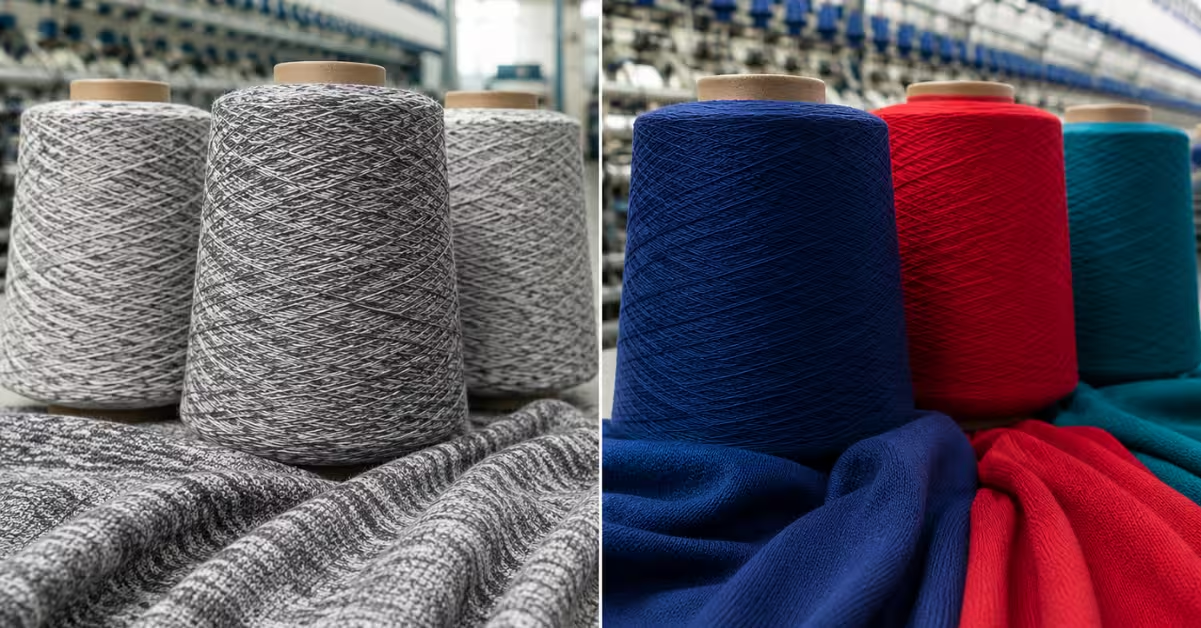
Melange yarn and solid-dyed yarn offer different advantages depending on the fabric, appearance, cost, and production requirements. For buyers, understanding these differences can help determine which yarn is the better fit for a particular order.
Where the Color Comes From
Melange and solid-dyed yarn part ways at the point where color enters the process.
Melange yarn is colored before it’s even yarn. Two fiber batches, usually a raw or undyed one and a dyed one, are blended at the fiber stage, so the color mix is spun directly into the strand. That’s what gives it the heathered, slightly grainy look, rather than a single flat tone. We go through the full process in our piece on what melange yarn is and how it’s made, but the short version is that the color goes in before spinning, not after.
Solid-dyed yarn works the other way around. The fiber is spun first, then dyed to a uniform shade as finished yarn (or later as fabric). There’s no blending at the fiber stage, no flecking, no built-in texture. Just one consistent color across the batch.
That’s really the whole difference. Everything else follows from it.
The Different Yarn Dyeing Methods
A few dyeing methods get lumped together that shouldn’t be.
Fiber or stock dyeing happens to loose fiber before spinning. This is what produces melange yarn, though it’s also used any time a mill needs a mixed-fiber effect that isn’t necessarily heathered.
Yarn dyeing, done in package or hank form, colors yarn that’s already spun, to a solid shade. Most solid-dyed yarn used for stripes, checks, and yarn-dyed wovens comes from this step.
Piece dyeing happens even later, after the fabric or garment is already knitted or woven. Buyers sometimes confuse this with solid-dyed yarn, but it’s a separate stage further down the chain.
Melange happens earliest. Solid-dyed yarn happens a step later. Piece dyeing happens later still. Which stage your supplier is actually dyeing at changes your lead time, your MOQ, and how much shade risk lands on you.
Why Buyers Order Melange
The texture reads as intentional rather than plain, which is why melange shows up on basics like tees, joggers, and hoodies that need to look a bit more finished without any extra work on the garment.
It also hides flaws well. Small slubs, light staining, and minor soiling all disappear more easily against a heathered background than against a flat solid, which matters for high-volume basics and kidswear, where some imperfection is unavoidable.
It ages better, too. Because the surface already has variation built in, early pilling or fading doesn’t stand out as much as it would on a solid color, where any texture change is immediately obvious.
There’s a sustainability angle as well, though it comes with a caveat. Dyeing at the fiber stage can mean less water and fewer chemical passes than dyeing finished fabric, and it pairs well with recycled or leftover fiber. That’s a real advantage, but it depends entirely on how a specific mill runs the process. Ask for numbers, not just the pitch.
Why Buyers Order Solid-Dyed
If a brand needs an exact Pantone match, whether for a uniform program, a signature color, or anything with a licensed spec, solid-dyed is the only option. By definition, Melange’s blended tone can’t hit a single exact shade.
Quality control is simpler, too. One shade is easier to inspect than a blend ratio that has to hold steady across an entire lot.
Patterns need it as well. Stripes, color-blocking, jacquards, and engineered prints depend on solid-dyed yarn in precise shades placed exactly where they’re supposed to go. A melange tone doesn’t behave the same way in a tight repeat.
And reorders tend to go faster. Matching a previously approved solid shade is usually more straightforward than matching a melange blend, where a small shift in the dyed-fiber ratio changes the whole look.
So Which Do You Order?
Start with the garment, not the trend.
If you need an exact brand color, order solid-dyed. If you’re sourcing basics where hiding small flaws matters more than an exact shade, melange is a better fit. If the design is pattern-heavy, solid-dyed gives you the control those constructions need. If it’s a high-volume, price-sensitive basics program, melange can lower your rejection rate at scale.
If you’re trying to back up a sustainability claim, either method can support one, but ask your mill for actual data on fiber source, dye process, and water use rather than assuming melange wins by default. A certification from a body like OEKO-TEX verifies safety and environmental performance that the dyeing method alone doesn’t.
Most sourcing calendars end up ordering both: melange for casual basics and solid-dyed for anything that needs an exact, repeatable color. The mistake isn’t choosing one over the other. It’s choosing without asking your mill which one runs well.
One More Thing Before You Order
Whichever method you go with, the same risk applies. A mill telling you it can do something and a mill that can consistently deliver it at scale are two different claims. Our guide to mistakes to avoid when buying yarn from Bangladesh covers the sourcing missteps that catch buyers most often, regardless of the dyeing method you choose.
Not sure which one fits your next style? Karotoa Green runs both melange and solid-dyed lines with tight lot control either way. Send Karotoa Green your fabric specification, and they’ll tell you plainly which method makes sense for your order.
