

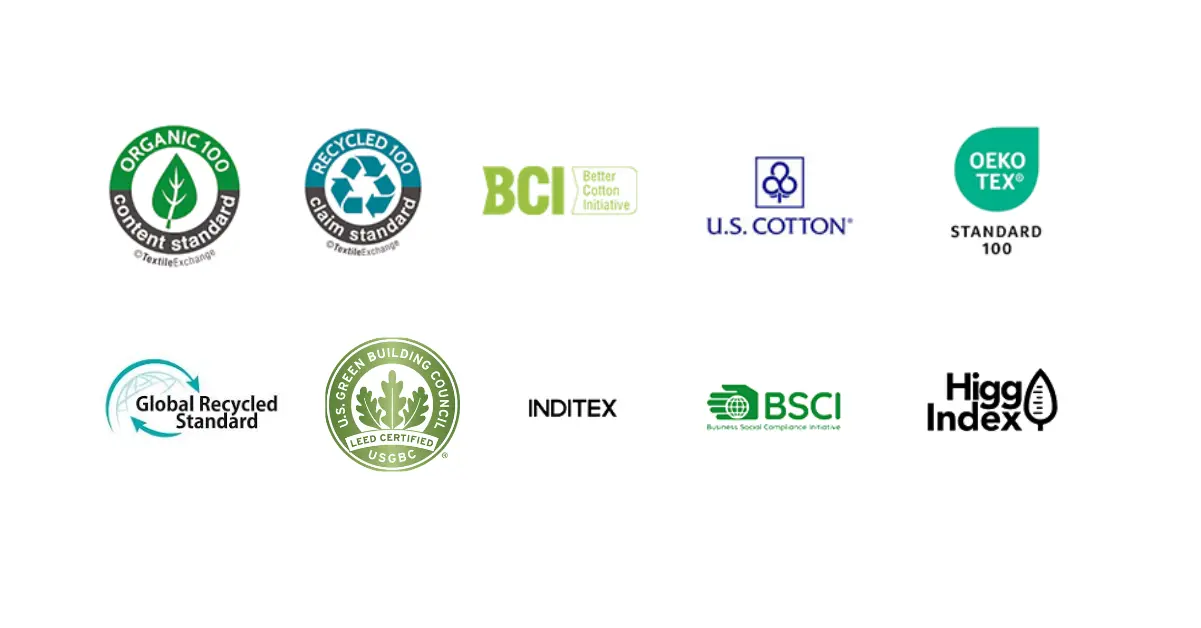
A shade card and a spec sheet used to be enough to close a yarn order. Now, a buyer’s compliance team wants to know if the cotton is organic, whether the recycled content is actually verified, and which body signed off on it. Increasingly, if a mill can’t answer that clearly, the order just doesn’t happen.
Part of the problem is that the certification landscape has gotten crowded, and the acronyms overlap just enough to cause real confusion. GOTS, OCS, GRS, RCS, BCI, they all sound like they’re checking the same kind of thing, but they’re actually verifying different pieces of the supply chain. Mix them up, and you can end up sourcing the wrong yarn for what the buyer actually asked for.
GOTS
GOTS stands for Global Organic Textile Standard, and it’s one of the more demanding certifications on this list because it extends beyond the raw fiber. It follows the product through spinning, dyeing, and finishing, all the way to labeling, layering environmental and social criteria on top of the organic fiber requirement. A product needs a minimum share of certified organic fiber to qualify, but that’s only the starting point. Every processing stage after that has to meet the standard, too, so it’s not enough for the cotton itself to be organic if the downstream dye house doesn’t meet the same bar.
OCS
OCS, the Organic Content Standard, is a narrower cousin of GOTS. It confirms that a product genuinely contains the organic fiber it claims to, tracing that fiber from the farm through to the finished yarn, but it skips the broader environmental and social requirements that GOTS applies at every processing stage.
This is really the question buyers ask most often: what’s actually different between GOTS and OCS? OCS answers, “Is the organic content in this yarn real and traceable?” GOTS answers that same question and also checks how the whole thing got processed along the way. A yarn can carry OCS certification without ever meeting GOTS, but GOTS effectively covers what OCS verifies as part of a bigger standard.
GRS
GRS, the Global Recycled Standard, does for recycled material roughly what GOTS does for organic. It verifies recycled content throughout the supply chain and adds environmental and social requirements at processing stages, using the same basic logic as GOTS, just applied to recycled rather than organic fiber.
This one is becoming more relevant for melange and blended yarns specifically, since recycled polyester and recycled cotton keep showing up more in blended melange constructions as buyers push for sustainability claims they can actually back up, rather than vague marketing language.
RCS
RCS, the Recycled Claim Standard, sits next to GRS the way OCS sits next to GOTS. It confirms that recycled content is real and traceable through the chain, but without the additional environmental and social processing requirements that GRS adds. If GRS is the fuller standard, RCS is the leaner one, focused specifically on proving the recycled content claim itself.
BCI
BCI, now generally called Better Cotton, is a different animal entirely from everything above it. It isn’t a certification attached to a specific finished product, the way GOTS or GRS are. It’s a program built around training farmers to grow cotton with less water and fewer harmful chemicals, and the cotton produced under it is tracked through a mass balance system rather than a strict physical chain of custody.
This is where buyers get tripped up more than anywhere else in this comparison. Better Cotton is not organic cotton, and yarn made from it doesn’t carry an organic claim. It’s a separate sustainability track focused entirely on farming practices, and it’s worth being precise about that when a buyer specifically asks for it.
Making Sense of the Comparison
Laid out together, the pattern is fairly simple once you see it. GOTS and GRS are the more comprehensive standards, covering both fiber content and processing conditions across the supply chain. OCS and RCS are the narrower versions that verify fiber content and traceability without the added processing requirements. BCI stands apart from all four by focusing on how cotton is farmed rather than certifying finished yarn or fabric.
None of these is interchangeable, and none of them is automatically the “better” one in isolation. What actually matters is matching the certification to what a buyer is trying to verify, whether that’s organic content, recycled content, or sustainable farming, rather than assuming any single acronym covers everything.
Textile Exchange manages or contributes to several of these standards directly, and their published resources are worth checking if you want the full technical criteria behind any of them instead of a summary.
What to Actually Ask a Mill
If a certification matters for your order, ask for the real certificate and its scope, not just a verbal claim that a mill is certified. These certifications are issued for specific facilities and product scopes, so a mill being GOTS certified at one factory doesn’t mean every yarn they produce anywhere is GOTS certified. Ask which certificate applies to the specific yarn you’re ordering, and check that it’s still current, since renewals and audits are required periodically.
At Karotoa Green, we hold the certifications relevant to organic and recycled fiber content on the lines that need them, and we’re upfront about exactly which certificate applies to which product. If certification scope matters for your sourcing decision, reach out, and we’ll walk you through what applies to your order.
