

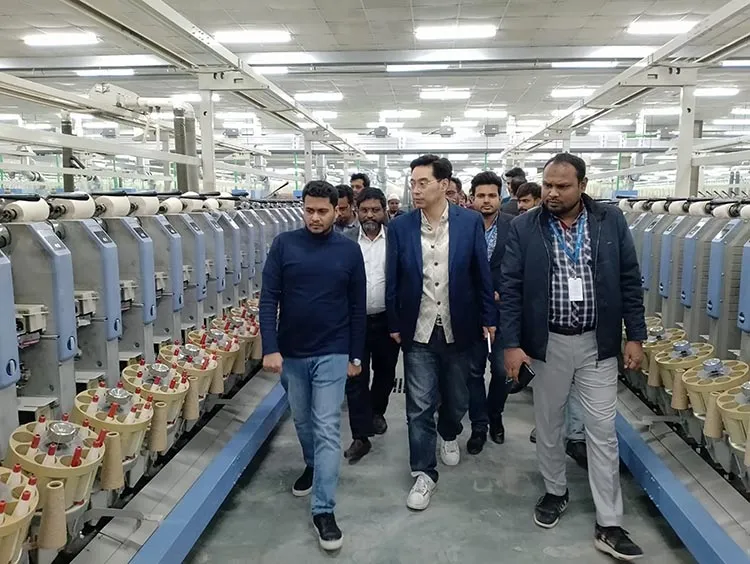
Automating a machine and connecting it are two different things. A mill can run fully automated spinning frames, autoconers, and blowroom lines, yet still have no real visibility into how the system is performing, because each machine is its own island, reporting to its own panel and checked by someone walking the floor. IoT is what turns a mill full of automated machines into a mill that actually knows what’s happening across the whole floor in real time.
This is really the layer that comes after automation, not instead of it. Automation enables a machine to run without a person operating every step. IoT is what lets someone see, from a single screen, whether that machine, and every other machine like it, is actually running the way it’s supposed to.
Automation Versus Connected Automation
A spinning frame that runs on its own is automated. A spinning frame that runs on its own and also streams its production data, its stoppages, its quality readings, to a central system in real time is something else, and that difference matters more than it sounds like it should.
Without connectivity, a mill’s automation is a set of separate improvements. Each machine works better on its own, but nobody upstairs has a clear picture of the floor as a whole without physically walking it or waiting for shift-end reports. With IoT layered on top, all of that data starts flowing to one place, and patterns that were invisible machine by machine, a specific frame underperforming across every shift, a particular line losing time to the same stoppage repeatedly, suddenly become obvious.
What Industry 4.0 Actually Looks Like on a Spinning Floor
Industry 4.0 is often used as a buzzword, but in a spinning mill it comes down to a fairly specific set of things happening together.
Sensors on individual machines feed production counts, stoppages, and quality metrics into a shared network rather than staying local to each machine’s own display panel.
A central dashboard pulls that data together so a production manager can see the entire floor’s status from one screen, rather than piecing it together from separate reports written up machine by machine or shift by shift.
Historical data gets stored and becomes searchable, which means a mill can actually answer questions like which machine has the highest downtime this quarter, or which shift consistently runs slower starts, instead of relying on someone’s general impression of how things have been going.
Alerts are pushed to the people who need them, not just displayed on a panel that’s only checked when someone happens to walk by.
What a Smart Dashboard Actually Shows
A well-built dashboard for a spinning mill usually pulls together a handful of components into a single view. Machine-level production output is updated continuously rather than at shift-end. Defect rates by machine and by shift, which is often where the earliest sign of a mechanical problem shows up, long before it becomes an actual breakdown. Utilization and downtime, broken out by cause, so a mill can see whether it’s losing time to maintenance, to changeovers, or to something else entirely. And energy consumption, which for a spinning mill running hundreds of motors around the clock is a meaningful cost in its own right.
The value isn’t really the dashboard itself. It’s that a manager can look at one screen and know where to focus attention, instead of finding out three days later that a specific line had been underperforming all week.
Why This Connects to Quality and Maintenance, Not Just Production
None of this sits apart from work a mill is probably already doing elsewhere. A dashboard pulling in real-time defect data is really an extension of the same inline sensor systems we covered in digital quality control and yarn sensors, just surfaced in a way a manager can act on across the whole floor, rather than machine by machine. And the same connected data feeding a smart dashboard is exactly what makes predictive maintenance possible in the first place, since flagging a machine before it fails depends on that machine’s data actually reaching someone in the first place. It’s all really one continuation of the shift we described in automation in yarn manufacturing: automation gets the machine running on its own, and IoT is what connects it to everything else.
The Broader Industry Picture
This shift isn’t unique to any one mill. Trade coverage from outlets like Fibre2Fashion has tracked how smart factory adoption is spreading across textile manufacturing more broadly, and spinning is very much part of that pattern rather than an outlier. Mills that are further along on automation tend to be the ones adopting connected dashboards fastest, too, mostly because the sensor infrastructure is already there. Adding the dashboard layer on top is a smaller lift than building the whole thing from scratch.
What This Means if You’re Sourcing Yarn
A mill running IoT-connected floor monitoring isn’t just running a more modern operation for its own sake. It’s a mill that catches quality and maintenance issues faster, which tends to translate into fewer surprises on delivery timelines and more consistent yarn from batch to batch. When you’re evaluating a supplier, it’s worth asking not just whether their machines are automated, but whether that data actually goes anywhere, and whether anyone’s watching it in real time.
At Karotoa Green, our spinning floor feeds into a connected dashboard covering production, quality, and machine health together, not as three separate reports someone has to reconcile at the end of the week. If a supplier who actually sees problems coming matters for your next order, reach out, and we’ll show you how our floor data works.
