

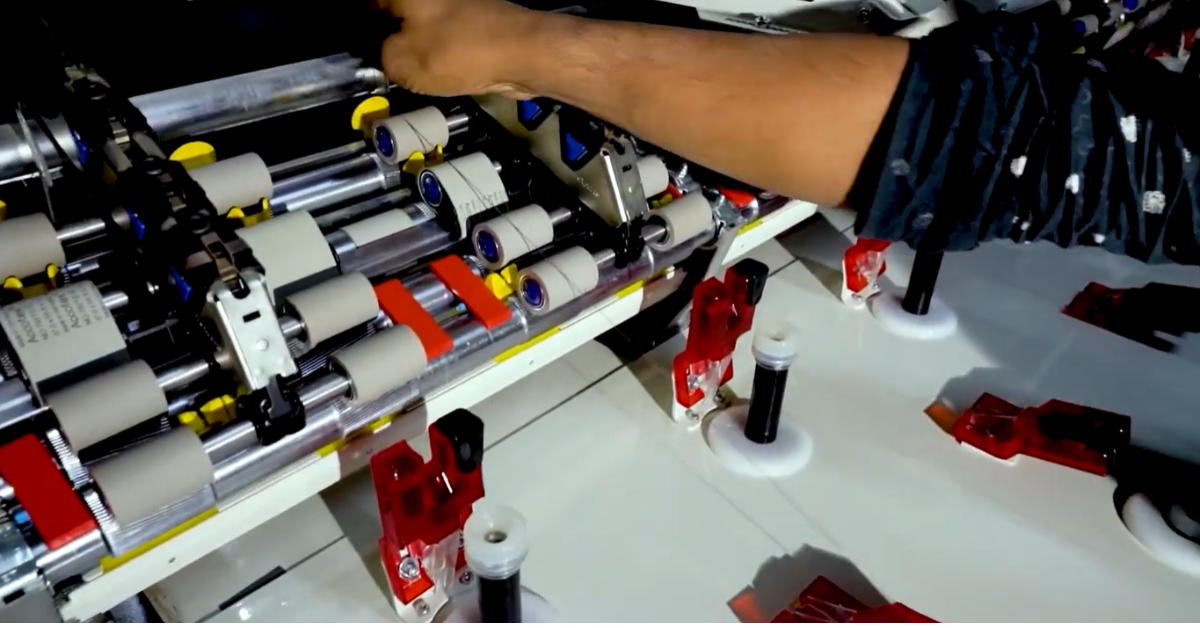
Two mills can run the exact same spinning frame, the same fiber, the same blend ratio, and still turn out yarn with different consistency. Machines don’t run themselves, not fully, and the gap between a well-run frame and a poorly run one usually comes down to the person operating it. A rushed doffing, a missed sign of uneven tension, a piecing job done carelessly- none of these show up as a machine fault. They appear as a quality issue traced back to training.
This is the part of yarn consistency that doesn’t get talked about as much as automation or sensors, but it matters just as much. Here’s how mills actually build operator skill, and why it’s harder than just handing someone a manual.you can read our guide IoT and Smart Dashboards – The Next Step After Automation in Spinning.
Skill Still Sits at the Center of Spinning, Even With Automation
Automated frames and sensor-driven quality checks have cut down how much depends on an individual operator’s judgment, but they haven’t eliminated it. Someone still has to piece a broken end correctly, recognise when a machine’s running slightly off before a sensor flags it, and know when a yarn defect calls for stopping the frame versus letting it run to the next scheduled check.
A poorly trained operator working on a fully automated line can still introduce inconsistency, just in different places than they would on an older, more manual setup. Training hasn’t become less important as mills automate. It’s shifted toward different skills: reading dashboards, understanding what sensor alerts actually mean, rather than purely manual dexterity.
What Operator Training Actually Covers
New operators generally start with the fundamentals of fiber and yarn behavior, understanding how different fibers respond to tension, twist, and humidity, since a lot of quality problems trace back to an operator not recognizing how a particular blend behaves differently from what they’re used to.
Machine-specific training follows, learning the actual spinning frame or autoconer they’ll be running day to day, including how to recognise early signs of mechanical issues rather than only reacting once a machine stops outright.
Piecing technique gets its own dedicated attention, since a poorly pieced yarn join is one of the more common sources of thick places and weak spots that show up later as quality complaints. This is one of the areas where hands-on repetition matters more than classroom instruction.
Quality standards training teaches operators what an acceptable defect threshold actually looks like, both visually and against instrument readings, so operators aren’t relying purely on instinct when deciding whether something needs attention.
And increasingly, dashboard and sensor literacy is part of the curriculum too, teaching operators to read the same data systems that are feeding predictive maintenance and quality monitoring, so a trained eye and the machine’s own alerts are working together rather than one ignoring the other.
Textile Workforce Training in Bangladesh’s Broader Context
Bangladesh’s spinning sector has grown fast enough that workforce training has had to scale alongside it, not always evenly. Some mills run structured, ongoing training programs with dedicated trainers and formal certification paths for operators moving up in skill level. Others rely more on informal, on-the-job learning passed from experienced operators to newer ones, which works reasonably well for basic tasks but tends to fall short when it comes to more complex quality judgment calls.
The gap between those two approaches is a big part of why yarn quality varies as much as it does between mills running comparable machinery. A mill investing in structured training isn’t just being generous to its workforce, it’s protecting the consistency of what it ships.
We’ve covered the direct link between training investment and yarn output in more detail in how training improves yarn quality in spinning mills, and the wider picture of how Bangladesh’s spinning sector is building up its skilled workforce more broadly in skilled workforce development in Bangladesh’s spinning sector.
Where Industry Bodies Fit In
Organizations like BTMA, the Bangladesh Textile Mills Association, play a role here too, representing the primary textile sector and pushing on issues that affect the industry’s workforce and production capacity more broadly. Their involvement matters for buyers mainly as a signal of how organized and accountable the sector is at an industry level, beyond any individual mill’s own claims.
What This Means When You’re Evaluating a Mill
Training is one of the harder things to verify from outside a mill, since it doesn’t show up on a spec sheet the way certifications or machine lists do. It’s still worth asking about directly. Does the mill run structured training for new operators, or is it mostly informal? How does an operator get promoted to running more complex machinery? Is there a quality feedback loop where defect trends actually get traced back to training gaps and addressed, rather than just noted and moved past?
A mill that can answer those questions clearly is usually one where consistency isn’t an accident.
At Karotoa Green, we run structured onboarding and ongoing skill development for our spinning operators, tied directly to the quality data we track on the floor. If operator consistency is part of what you’re evaluating in a supplier, reach out, and we can walk you through how our training actually works.
